Heather Poole, a veteran American Airlines flight attendant with three decades of experience, has publicly criticized the carrier’s newest long-haul aircraft, the Airbus A321XLR. After flying the plane on its inaugural international route from New York (JFK) to Edinburgh (EDI), Poole detailed significant operational and comfort issues that affect both crew and passengers.
Her critique highlights a growing tension in the aviation industry: as airlines push narrow-body jets into long-haul markets to maximize route efficiency, they often compromise on cabin ergonomics and crew welfare.
Operational Challenges on the A321XLR
Poole, who has written a book about her career and maintains an active presence on social media, shared a comprehensive list of grievances regarding the aircraft’s design. While the A321XLR is marketed as a tool to unlock point-to-point routes that are not viable for larger wide-body planes, Poole argues the current configuration is not “flight attendant friendly.”
Key issues identified by Poole include:
- Air Quality Concerns: She reported smelling fumes before takeoff on both legs of the journey, noting that this remains a persistent issue with Airbus aircraft.
- Inefficient Galley and Bathroom Layout: With only one lavatory in the front and three in the rear of the coach section, staff are frequently forced to move service carts to allow passengers to pass, disrupting service flow. The galley space itself is described as tight, making trash management difficult.
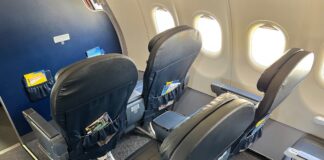
- Cabin Congestion: First-class aisles are so narrow that passing passengers is nearly impossible without physically moving them. Additionally, entertainment screens must be manually pushed aside during service, slowing down operations.
- Meal Service Difficulties: Tray tables in premium economy and coach are too small for standard meal configurations, forcing staff to stack items precariously.
The “Crew Rest Tent” Controversy
Perhaps the most visually striking complaint concerns the crew rest area. On long-haul flights, crew rest is essential for safety and performance. On the A321XLR, this space consists of three seats in the last row, enclosed by a simple curtain or “tent,” located directly adjacent to the lavatories.
Poole shared video footage of the area, sarcastically noting the lack of amenities: “Here’s the crew rest, here are all the blankets, I don’t even know what to do with them. This is our little tent, right next to the bathroom… isn’t this exciting.”
This design choice raises questions about how airlines prioritize crew well-being when maximizing seat density. While convertible crew rest areas are common on narrow-body jets, placing them next to high-traffic, high-noise zones like lavatories can severely impact rest quality.
A Culture of Public Criticism
Beyond the physical design flaws, Poole’s post has sparked debate about workplace culture in American aviation. Unlike many non-US airlines, which often enforce strict social media policies prohibiting employees from disparaging their employer, American Airlines appears to tolerate Poole’s frequent public critiques.
The Association of Professional Flight Attendants (APFA), the union representing American Airlines flight attendants, advises members to “refrain from disparaging comments or reviews of the Company.” However, enforcement seems inconsistent. Poole has continued posting negative feedback for years without apparent repercussion, leading to mixed reactions. Some view her transparency as refreshing and necessary for accountability, while others question the professionalism of consistently criticizing an employer publicly.
The Broader Implications
Poole’s experience with the A321XLR underscores a critical challenge in modern aviation: the race to optimize cost-efficiency often comes at the expense of human-centric design. As airlines deploy narrow-body jets on longer routes to compete with traditional wide-body services, the pressure to minimize space for crew rest and service areas intensifies.
“It’s not flight attendant friendly. Hard to work, especially in first class.”
The A321XLR is still in the early stages of its deployment with American Airlines. As the fleet expands, the airline will need to address these operational bottlenecks and crew comfort issues. If left unresolved, such design flaws could lead to decreased crew morale, slower turnaround times, and a diminished passenger experience—ultimately undermining the very efficiency gains the aircraft was meant to deliver.
In short, while the A321XLR promises new route possibilities, its current execution suggests that the human element of flight operations is being overlooked in favor of structural compactness.