


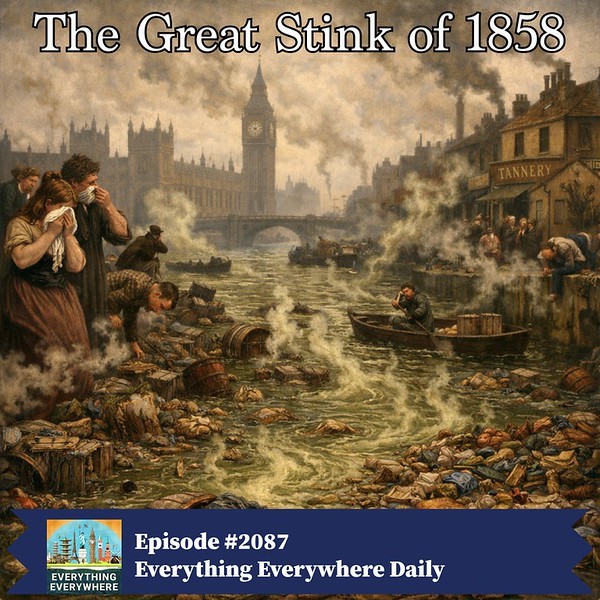
In the summer of 1858, London faced a crisis unlike any other: the overwhelming stench of the River Thames. This event, known as the Great Stink, wasn’t just a matter of discomfort; it exposed a city struggling with its own waste, forcing a reckoning with public health and infrastructure. The crisis reshaped London and set new standards for urban planning.
The Industrial Roots of the Crisis
By the mid-19th century, London was the world’s first major industrial city, and this growth came at a cost. The rise of coal-powered steam engines fueled the Industrial Revolution, but also filled the air with soot and polluted waterways. Writers like Charles Dickens vividly depicted this environmental devastation, documenting how factories contaminated the Thames with industrial waste.
London’s population exploded from 1 million to 2.5 million by the mid-1800s, exceeding 6 million by the early 20th century. This rapid growth overwhelmed the city’s infrastructure. Its sewer system remained outdated, consisting of underground channels that dumped waste directly into the Thames – the same river that supplied drinking water.
Cholera and the Miasma Theory
Recurring cholera outbreaks plagued London due to this contamination. The 1831 outbreak alone killed 30,000 people. It wasn’t until John Snow’s work in 1854 that the link between contaminated water and cholera became clear. At the time, the dominant theory was the “miasma theory,” which blamed disease on corrupted air, ironically ignoring the filth in the water itself.
A City Drowning in Waste
London’s rapid population growth led to unsanitary living conditions. Homes lacked toilets, so residents dumped waste into the streets, creating inches-deep layers of human and animal excrement. Up to 300,000 horses resided in London, each producing 30 pounds of manure and liters of urine daily. Rain washed this runoff into the archaic storm system, ultimately flowing into the Thames.
Dickens predicted this outcome in his novel Little Dorrit, lampooning the city’s bureaucratic failures through the fictional “Circumlocution Office,” a body designed to avoid action. Dickens further criticized the sewage problem in Household Words, describing the Thames as festering with filth from hundreds of thousands of people.
Faraday’s Warning
Michael Faraday, London’s most famous scientist, was among the first to sound the alarm. In 1855, he conducted simple experiments dropping white cardstock into the Thames, noting that it disappeared before sinking an inch due to the opaque, brown water. He published his findings in The Times, warning that inaction would lead to disaster.
The Breaking Point: Summer of 1858
In the summer of 1858, temperatures soared to 118°F (48°C), exacerbating the crisis. Centuries of waste fermented in the river, unleashing a relentless stench that overwhelmed the city. Cartoons in The Times depicted Father Thames rising from a stew of filth, capturing the horror. Parliament, which had just relocated to Westminster on the Thames, was at the epicenter.
Members of Parliament fled their offices, resorting to coating curtains with calcium hypochlorite in vain. Even Queen Victoria and Prince Albert attempted a boat ride on the Thames, but retreated after only minutes as the stench and visible waste became unbearable.
The Solution: Bazalgette’s System
The solution had been proposed decades earlier by landscape artist John Martin, who advocated for embankments to capture waste and divert it away from the river. However, it took the Great Stink to finally spur action. Joseph Bazalgette, Chief Engineer of the Metropolitan Board of Works, designed a revolutionary sewer system.
Bazalgette’s plan involved running sewers parallel to the river, extending them to the ocean. He convinced Parliament to expand pipe sizes, anticipating London’s continued growth. The use of Portland Cement ensured the system’s durability. The resulting network, spanning 82 miles of main intercepting sewers and over 1,100 miles of street sewers, effectively removed waste from the Thames.
Legacy of the Stink
The Great Stink forced London to confront its waste problem, leading to one of history’s greatest engineering feats. Bazalgette was knighted, and his system remains structurally sound over 160 years later. This crisis proves that sometimes, progress isn’t driven by innovation but by the desperate need to escape intolerable conditions.
The Great Stink is a stark reminder that even the most advanced cities can be brought to their knees by basic infrastructure failures, and that sometimes, the greatest achievements come from the most unpleasant circumstances.


